









California Zinfandel
|
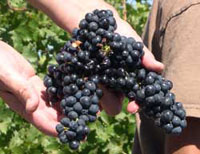 |
Ask
someone who lives on a tropical island, but who originally came
from more northerly climes, what he misses most about "home,"
and he’ll often tell you it’s autumn — the creeping
chill, the deepening colors and aromas of spices and ripening fruit
in the air.
If there is any wine that captures that autumnal feeling perpetually
in the glass, it’s the California red wines made from the
Zinfandel grape. The varietal characteristics of Zinfandel are often
described as berryish — more precisely, like raspberry or blackberry
jam, mixed with aromas of freshly ground pepper and often cinnamon
and clove.
But
Zinfandel is more than a flavor, it’s also an experience:
At its fullest, red Zinfandel almost gushes, like liquid cornucopia,
out onto the palate. The color is vividly purple — sometimes
black as a moonless night. The aromas are ripe and intense, and
the feel in the mouth vigorously alive, dense, almost decadent with
those wild berry qualities.
Zinfandel is also versatile; grown, as it is, in virtually all the
wine regions of California. Zinfandels come light and easy and Zinfandels
come thick and plodding. They can be straightforwardly berryish,
or they can be layered and complex with multiple fruits, oak and
spice.
Until not too long ago, most Zinfandels were
soft, simple affairs; not too different from easy drinking French
Beaujolais or Italian Valpolicella: good spaghetti wines. Then again,
who doesn’t need a wine for spaghetti?
The image of many of today’s Zinfandels is more serious. While
still piquant and fruity, they can also be bigger, oakier, more
refined and complex, and possibly capable of at least some bottle
aging. In this respect, they are closer to classic French varieties
such as Cabernet Sauvignon and Pinot Noir. The
best Zinfandels, in other words, can be great.
What Makes for a Great Zinfandel?
What makes for great Zinfandel? Dusting off an old wine journal, we recently reread some notes on one of the more memorable California classics: the 1977 Clos du Val Zinfandel from Napa Valley. This particular bottling was as explosive as anything we’ve ever had since. At the ripe, young age of three or four years, the wine’s dimensions broke down into three main categories:
1. An exceptional full body — a heart-pounding 14.5 per cent alcohol size and generosity of tannin, thickening the palate without hurting it. To heck with subtlety, it was the immense, dramatic feel that still makes this wine burn in our memory.
2. An almost dizzying array of aromas. First, the distinct blackberry Zinfandel fruitiness, ripe without being overripe or pruney. Second, a pungent, spicy note, like sticking your nose into the bottom of a pepper grinder. Third, the deep, warm, vanilla-like fragrance of French oak. Whereas most Zinfandels of the late ’70s (and even up until today) are aged in rawer-scented American oak barrels, the use of French oak in an American Zinfandel in the late '70s was like dressing a pauper like a prince… and it worked!
3. A terrific balancing acidity — lifting the
natural fruit qualities — filled out by the wonderful feel of
glycerol (a higher alcohol component), adding up to a sleek texture
and overall sense of grace and proportion in spite of the wine’s
giant size and fruitiness.
We
never thought of a big, California-hewn Zinfandel as something that
could possibly be described as "elegant" until that '77
Clos du Val; vinified, as it were, by Bernard Portet, a winemaker
originally born, raised and trained in France’s Bordeaux region.
Pairing Zinfandel
 |
So
like the classic red Bordeaux (and their California counterparts
made from Cabernet Sauvignon), we ended up enjoying the Clos du
Val, and many of the finer, more complex Zinfandels tasted since, in a variety of food contexts. There
is little argument that beef is always best with Cabernet Sauvignon,
but a sturdy, sweetly berryish Zinfandel goes amazingly well with
roasted prime rib bathed in horseradish-tinged natural jus; better
yet, thin slices steeped in soy, sugar, sesame, garlic and ginger
in the fashion of Japanese, Mongolian and Korean marinades, charcoal-grilled
or seared on a smoking hot iron, and plopped on steamy white rice.
It’s also said that lamb calls for Cabernet Sauvignon or Bordeaux.
In the late 1970s, both Montevina and Carneros Creek Winery made
a number of positively black, jammy, cinnamon-and-pepper spiced
Zinfandels, inundated with oak and 14 per cent-plus alcohol, that bring
back fond memories of drinking with legs of lamb caked with mustard,
as well as racks of spring lamb grilled on the "barbie"
with chunks of eggplant, or coming out of the roaster dripping with
buttery bread crumbs and slathered with sweet mint
jelly. It was a great time to be young, in love, and more naturally
trim around the waist!
Zinfandel and Italian Food
Because
of their mildly acidic, zesty quality, many Zinfandels make a sensible
match with Italian inspired meals. Start it off nice and easy with
a classic: an antipasto plate — roasted bell peppers, marinated
mushrooms, egg fritters, soft, springy Mozzarella and all — washed
down with one of those curiously pink (more like pale salmon) "White"
Zinfandels. Typical bottlings such as Sutter Home and Beringer may
be unabashedly fruity, but are no-brainers with first bites generously
drizzled with sweet, winy balsamic vinegars.
Second course: a pasta such as fettuccine tossed with mushrooms
and parmigiano, or linguine with clams, mussels, tomato, garlic
and some pungently defined cheese like pecorino. This is where the
moderately scaled red Zinfandel classics — like Louis Martini
or Sebastiani or the lighter coastal blends by Ridge Vineyards — start
to shine. You really don’t want a big, hunky style of Zinfandel
with pastas; just something moderate, easy, bright and snappy, and
that can even be served slightly chilled (or on ice cubes, on a
warm day).
For
the meat
course, you’ve got the fats and proteins for the most
concentrated Zinfandels, ripened long enough to reach alcohol levels
ringing past 14 per cent and even 15 per cent, with corresponding levels of tannin
and jammy fruit intensity. It doesn’t have to be lamb and
beef, especially since pork — a roast dripping in juices, pan
fried with rosemary, or smothered in white wine and herbs — may
very well be the ideal foil for the biggest and baddest brands,
such as the single-vineyard bottlings of Ridge, Turley, Ravenswood,
De Loach, and Rosenblum.
But will the big, bad Zinfandels age? Who cares? At just three,
four, or five years of age they are perfectly delicious. In fact,
there are more than a few aficionados who believe that if laid down
for over, say, eight years, a high-alcohol Zin begins to lose its
fruitiness, thus leaving a wine that tastes more of bitter tannin
and mouth burning alcohol.
So you should never be afraid to open a brand new bottle of Zinfandel,
red, pink, young or old. In fact, pour any of the better ones into
a good sized (at least 14 oz.) glass and smell… ahh, autumn!
Related Content:
Top Rated Zinfandel
More Wine & Food Pairing
A Plot as Thick as Zinfandel


|

ULH12116 |

Sip on GAYOT's picks of the best small-production craft beers.
Sip straight or mix up a margarita with GAYOT's picks of the best tequilas under $100.
 Facebook
 (formerly Twitter)
 Instagram