|
The
Acid Test — Sauvignon Blanc
by
Randal Caparoso
Comparing
Sauvignon Blanc with Riesling
Although
I do not fear low acid wines for food, there’s a lot to be
said for crisply balanced, elevated acidity of varieties such as
Sauvignon Blanc and Riesling.
 In the fall of 1992, I invited Peter Merriman, one of the founders
of the Hawaiian Regional Cuisine movement, to prepare a meal for
me in his style. Whether he’s aware of it or not, Peter’s
palate tends to veer on the acidic side. So his style of cooking
was just the thing I was looking for:
In the fall of 1992, I invited Peter Merriman, one of the founders
of the Hawaiian Regional Cuisine movement, to prepare a meal for
me in his style. Whether he’s aware of it or not, Peter’s
palate tends to veer on the acidic side. So his style of cooking
was just the thing I was looking for:
•
Quesadilla of Puna goat cheese, Kahuku shrimp & roasted macadamia
nuts
• Fresh Sharwell avocado, pomelo & orange salad with watercress
& arugula in fresh lime with honey
• Sesame crusted onaga (Hawaiian ruby snapper) with papaya
relish, spicy mango sauce & organic Big Island greens
 And the two wines I selected to match:
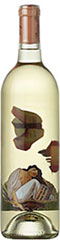
• Bonny Doon (left), “Pacific Rim” Riesling (California)
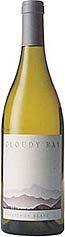
• Cloudy Bay (right), Sauvignon Blanc (New Zealand)
Although the possibilities offered by the unusually dry yet flowery,
fruity qualities of Bonny Doon’s new-wave style Riesling (from
grapes grown in Washington St. and Germany’s Mosel) are intriguing,
experience and instinct told me that the higher acid wine, the powerfully
aromatic Cloudy Bay Sauvignon Blanc – from one of the world’s
coldest climate growing regions – might prove to be the more
natural partner for these acid-driven dishes.
What I didn’t predict, however, was how well both wines would
do what they’re supposed to do, which is make a dish taste
better than it would without wine. A classic example of how this
works is French goat cheese (Chevre) matched with Loire River style
Sauvignon Blancs (such as Sancerre). Sharing common qualities of
sharp acidity and somewhat earthy grassiness, Chevre and Sancerre
have long been considered one of the best, if not predictable, food
and wine combinations in the world.
The goat cheese produced in the Big Island of Hawaii, however, is
milder and less acidic than traditional Chevres of France. In the
same fashion, the taste of Hawaii’s Kahuku-raised shrimp is
somewhat milder than shrimp raised in most parts of the mainland
United States.
So if it was just a mild dose of acidity and flavor that Merriman’s
goat cheese and shrimp quesadilla needed, it certainly was found
in the moderately crisp, fruity-scented Bonny Doon Riesling. But
the exuberantly zested, melony, citrusy and grassy qualities of
Cloudy Bay seemed to slice, dice and beg the palate to come back
for bite after bite of shrimp and goat cheese in the quesadilla.
In the second course, the dominant factors were the buttery avocado,
the pomelo’s plump, pink grapefruit taste, and the slightly
bitter edge of the greens. With the lime infused vinaigrette acting
as a conduit, the Riesling’s crisp, fragrant fruitiness did
a neat job of balancing out the leafy, citrus taste of the salad.
But again, it was the more intensely flavorful Cloudy Bay that added
a more palate-freshening dimension to this tropical style dish.
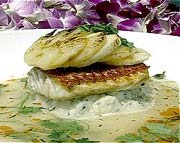 With
the onaga – a meltingly soft, mild and lush white Hawaiian
fish – Merriman snuck in a Malaysian chili spice into the
mango sauce, and so this sweet/spice interplay as well as the crunchy
freshness of the green beans all seemed to benefit equally by the
steely edge of the Riesling and the lavish, leafy greenery in the
Sauvignon Blanc. These two wines, from two different grapes from
different parts of the world, both make light, contemporary tropical
island dishes even fresher and livelier to the taste. With
the onaga – a meltingly soft, mild and lush white Hawaiian
fish – Merriman snuck in a Malaysian chili spice into the
mango sauce, and so this sweet/spice interplay as well as the crunchy
freshness of the green beans all seemed to benefit equally by the
steely edge of the Riesling and the lavish, leafy greenery in the
Sauvignon Blanc. These two wines, from two different grapes from
different parts of the world, both make light, contemporary tropical
island dishes even fresher and livelier to the taste.
Conclusions:
• Dishes utilizing vinaigrettes, citrusy (higher acid) fruits,
chili spices, and slightly bitter edged mesclun and other greens
could definitely benefit from higher acid varietals like Riesling
and Sauvignon Blanc (and maybe to a lesser extent, medium acid varieties
like Pinot Gris and Albarino).
• Although one may be conditioned to reach immediately for
authentic Loire River grown Sancerre or Pouilly Fume when served
a good Chevre, you can also find a good match in any number of the
world’s newer, crisp acid styles of Sauvignon Blanc, such
as those of New Zealand and the West Coast of the U.S. – especially
when goat cheese is used as a component in a dish with other ingredients.
• Dishes utilizing tropical fruit as a component, or in a
relish or sauce, do particularly well with more highly perfumed,
tropical fruit toned varieties – beginning with exuberantly
fruity Rieslings, and extending to the aromatic, fruit driven styles
of Sauvignon Blancs from the New World.
_____________________________________________
The
Ideal Sauvignon Food Matches
• Sauvignon Blanc is a quintessential white wine calling for
white meats (from fish and shellfish to chicken, pork or other white
meats). Its typically crisp acidic edge and moderately medium weight
does not lend itself to anything beyond that (it does not “cross
over” into red meats).
• The crisp, lean taste profile of Sauvignon Blanc does not
lend itself well to dishes containing disproportionate amounts of
butter or cream (use only with balancing ingredients like lemon
and capers, lest the wine turns unpleasantly sharp and the dish
too fatty or oily).
• While the finest Sauvignon Blancs are replete with qualities
of sweet melon (and sometimes citrus or fig), its propensity towards
nuances of green herbs, cut grass or weeds in the aroma and flavor
make it a natural with dishes utilizing leafy green herbs (parsley,
basil, chervil, and cilantro), and to a more limited extent, the
more strongly scented herbs (rosemary, thyme, marjoram and oregano).
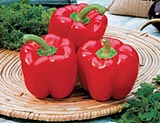 •
By the same token, herb nuanced Sauvignon Blancs do well with dishes
utilizing bell peppers (especially when roasted), olives, fennel,
spinach, watercress, arugula, and most green leaf salad vegetables. •
By the same token, herb nuanced Sauvignon Blancs do well with dishes
utilizing bell peppers (especially when roasted), olives, fennel,
spinach, watercress, arugula, and most green leaf salad vegetables.
• Restrained (n.b.) use of aromatically similar chili peppers
(most varieties) as well as chili spices, pastes and curry mixes
all stand to benefit from Sauvignon Blanc’s contrasting qualities
of moderate alcohol, palate-freshening acidity, and suggestions
of melon in the nose and flavor.
• Restrained use of lemon, citrus, pomegranate, tomatoes and
other acidic fruits underscore Sauvignon Blanc’s zesty acidic
qualities.
• Besides Chevre, other mildly acidic cheeses (Greek Feta,
Le Banon from France, Cabrales from Spain, Pecorino from Italy,
and extra sharp Cheddars) work well with Sauvignon Blanc.
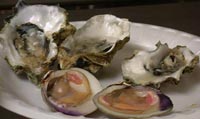 • Feel free to grill or smoke, as this brings out the minerally
or flinty qualities of Sauvignon Blanc (especially the French versions).
• Feel free to grill or smoke, as this brings out the minerally
or flinty qualities of Sauvignon Blanc (especially the French versions).
• While Sauvignon Blancs can certainly work well with richer,
fattier white meats (lobster, pork, whole chicken, etc.) with the
use of complimenting ingredients, its moderately weighted, crisp
quality is more naturally suited to lower fat seafood or white meats
(oysters, clams, flaky white fish, chicken breasts, veal, etc.).
• While Sauvignon Blanc is one of the few varieties that handily
match mild vinegars (particularly winy balsamic, sherry and rice
wine vinegars), these ingredients still need to be used in balance
lest the match turns into an exercise in sourness (in the dish as
well as wine).
• Since salt is more easily balanced by sweetness, don’t
expect bone dry Sauvignon Blancs to work like a charm with highly
salted or cured foods.
• For the same reason (the grape has tartness, but not sweetness),
use pickled vegetables with caution.
• While Sauvignon Blanc is indeed a food versatile grape,
it does not cross easily into the realm of Asian foods (use of ginger,
star anise, shoyu, kaffir, ponzu, and disproportionate use of sugar,
garlic, etc.). Better to leave that to more fragrant or aggressively
spiced varieties (i.e. Riesling and maybe Viognier among whites,
and Pinot Noir and Syrah among reds).
_____________________________________________
Known
& Loved Sauvignon Blanc Food Pairings
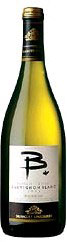 • Spring green salad with chevre and citrus in a caramelized
bell pepper
• Spring green salad with chevre and citrus in a caramelized
bell pepper
vinaigrette with a refined, stony scented Chateau Carbonnieux
Blanc
(Sauvignon Blanc dominated white from France’s Graves
in Bordeaux)
• Fresh snapper ceviche with tequila, lime and roasted
sweet peppers with a flinty, lemony Sancerre by Reverdy
• John Ash’s grilled marinated prawns with fresh
melon salsa, matched with a light, mildly crisp and easy
Fetzer Sauvignon Blanc
• Quenelles of lobster, scallops and leeks in a shiitake
shellfish consommé with a light, spring-fresh Frog’s
Leap Sauvignon Blanc from Napa Valley
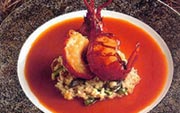 • Risotto of lobster and sea vegetables with English
peas and asparagus with an intensely herbal, zesty Brancott
New Zealand Sauvignon Blanc
• Risotto of lobster and sea vegetables with English
peas and asparagus with an intensely herbal, zesty Brancott
New Zealand Sauvignon Blanc
• Wood-grilled Anaheim chile stuffed with shrimp,
mint and red pepper
couscous with a lush, vibrant Matanzas Creek Sauvignon Blanc
• Spicy shrimp ravioli in a citrus achiote vinaigrette
with a crisply balanced Ferrari-Carano Fume Blanc
|
©
Randal Caparoso
|